


Now is a great time to take up a new hobby. In the technical age we are currently in, it is paramount that we find ways to unplug and the creative arts have proven health benefits and your new cork notebook journal is a blank canvas for you to fill however you choose.
You might like to journal all of your thoughts and write at length, this is absolutely fine. Go for it and let your creative thoughts flow. Or you might prefer to use your blank notebook for Mindful Journalling.
Be it for taking notes or journalling, studies keep identifying the benefits of writing by hand and in the fast-paced world how can we enjoy the benefits of writing while keeping up with the rest of technology?
Mindful Journalling is a way of capturing information as bulleted lists. Even if that seems too much to start with, you can take a moment each day to just write down one positive thing that has happened in your day, no matter how small; it is a great start to your journal journey.
Finding Stillness in the Scribble
In a world that demands our constant attention, finding a moment of genuine quiet can feel like a luxury. We often treat our thoughts like browser tabs, keeping too many open at once until the system (our brain) starts to lag. Mindful journalling is the manual override, it isn’t just about recording events; it’s about witnessing your own mind without judgement.
What Makes it “Mindful”?
Traditional journalling often focuses on what happened, writing about what you have done. Mindful journalling shifts the lens to how you feel about what happened. It is the practice of writing with presence, intention, and curiosity.
Instead of writing, “I had a stressful meeting,” a mindful entry might explore, “I noticed my chest tightening during the meeting when the deadline was mentioned. I feel a pressure to be perfect.”
The Core Benefits
-
Emotional Regulation: Putting feelings into words reduces the activity of the brain’s “alarm centre”.
-
Clarity: It helps untangle the “mental spaghetti” of daily anxieties.
-
Self-Compassion: By reading your thoughts back, you can often spot harsh self-talk that you wouldn’t use on a friend.
How to Begin Your Mindful Journal Journey
You don’t need a million tools or be a master of calligraphy skills. You just need ten minutes and a willingness to be honest with yourself.
-
Create a Ritual: Pair your writing with a physical cue like a cup of herbal tea, a specific chair, or lighting a candle. This signals to your brain that it’s time to decompress.
-
The “Check-In” Breath: Before your pen hits the paper, take three deep breaths. Notice where you are holding tension in your body.
-
Let Go of the “Inner Editor”: Ignore grammar, spelling, and structure. If you find yourself overthinking, simply write, “I don’t know what to write,” until a genuine thought surfaces.
Simple Prompts for Quiet Moments
If a blank page feels intimidating, try one of these “anchors” to get the ink flowing:
Why Cork is the Ideal Companion for Journalling
Choosing a cork notebook is more than just an aesthetic choice; it’s a tactile experience that aligns perfectly with a mindful lifestyle. As we move toward more conscious consumerism, cork has emerged as a front-runner for those who want their stationery to be as kind to the planet as it is to their thoughts.
1. Sustainable by Nature
Cork is one of the most eco-friendly materials on the planet. It is harvested from the bark of the Cork Oak tree, which is stripped away without harming the tree itself. The bark regenerates every nine years, making it a truly renewable resource. Furthermore, harvested cork trees absorb significantly more CO2 than unharvested ones.
2. Built to Last (and Travel)
Don’t let the soft texture fool you. Cork is incredibly durable and naturally resistant to many of the common “journal killers”:
-
Water-Resistant: Unlike fabric or paper covers, cork contains suberin, a waxy substance that makes it practically impermeable to liquids.
-
Scratch-Proof: It doesn’t scuff or peel like “vegan” plastic leathers.
-
Lightweight: It provides a sturdy hardback feel without adding unnecessary weight to your bag.
3. A Unique Tactile Experience
Mindfulness is about engaging the senses. The “honeycomb” cellular structure of cork gives it a warm, soft, and slightly cushioned feel. Unlike cold plastic or slippery faux-leather, cork feels organic and grounding in your hands, which can help settle your focus before you even begin to write.
Performance Comparison
Tips for Caring for Your Cork Journal
While cork is low-maintenance, a little care goes a long way in ensuring it lasts for years:
-
Cleaning: Simply wipe the cover with a damp cloth and a drop of mild soap if it gets dirty.
-
Aging: Much like real leather, cork develops a beautiful patina over time, darkening slightly and becoming even softer with use.
-
Storage: Keep it out of direct, intense sunlight for prolonged periods to prevent the natural pigments from fading.
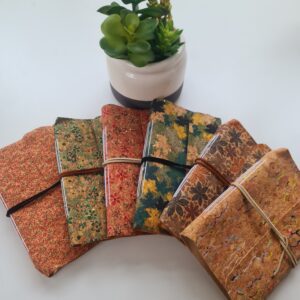
Did you know? No two cork notebooks are identical. Because the bark is a natural product, every cover features a unique grain and “fingerprint” of textures.
Cork Notebook Journals https://buyindie.co.uk/product/notebook-journals-cork-fabric/
Paper Insert Choices
The paper inside your journal is the “canvas” for your thoughts. Just as the cork cover provides the tactile exterior, the layout of the pages dictates the flow of your writing and the structure of your mindfulness practice.
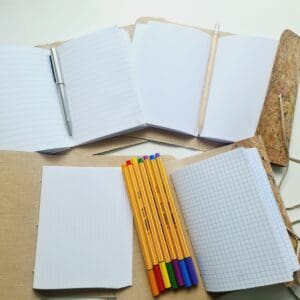
Choosing the right insert can significantly change how you interact with your thoughts. Here is a breakdown of the benefits for each popular paper type:
1. Ruled Lined: The Classic Narrative
Lined paper is the traditional choice for a reason. It provides a clear structure that keeps your handwriting neat and consistent.
Best For: Long-form “stream of consciousness” writing, daily diaries, and letters to yourself.
The Benefit: It removes the “blank page anxiety” by giving you a clear starting point and path. It’s perfect for those who want to focus entirely on the words without worrying about layout or design.
2. Dot Grid: The Versatile All-Rounder
A series of faint dots arranged in a geometric pattern. It offers the freedom of a blank page with the subtle guidance of a grid.
Best For: Bullet journalling, habit tracking, and “mixed media” entries (combining text with small sketches or diagrams).
The Benefit: The dots are unobtrusive; they disappear when you look at the page as a whole but provide perfect anchors for drawing straight lines, creating tables, or keeping your text aligned. It is the gold standard for those who like a tidy but flexible layout.
3. Plain White: The Creative Wildcard
Completely unguided, blank pages offer total freedom from constraints.
Best For: Visual journalling, mind-mapping, sketching, and those with non-linear thinking styles.
The Benefit: It encourages a “break the rules” mindset. Without lines to follow, you might find yourself writing vertically, drawing across the diagonal, or using larger, more expressive handwriting. It is the most “mindful” in the sense that it doesn’t force your thoughts into a specific shape.
4. Squared (Graph): The Logical Anchor
Traditional 5mm squares (or “quadrille” paper) provide the most rigid structure of the four.
Best For: Technical notes, precision tracking, list-making, and those who find comfort in symmetry.
The Benefit: Squared paper is excellent for “micro-journalling.” If you like to track data (such as sleep hours, mood levels, or step counts) alongside your writing, the grid makes it easy to create neat, professional-looking charts and boxes without the need for a ruler.
A Final Thought
Mindful journalling is a practice, not a performance. Some days will feel profound, and others will feel like a list of chores. Both are perfectly fine. The goal isn’t to produce a masterpiece; it’s to show up for yourself, one word at a time.
“I can shake off everything as I write; my sorrows disappear, my courage is reborn.” — Anne Frank
Over To You
Do you prefer to journal first thing in the morning to set an intention, or at night to clear your head; and which paper choice suits your style the most? Let me know in the comments below or you can tag me in your journal photos on Instagram or Threads @SarahLouCrafts.
Browse & buy your perfect Cork Journal from the range at:
https://buyindie.co.uk/product/notebook-journals-cork-fabric/
You can read all my other posts at https://buyindie.co.uk/store/sarahloucrafts/blogs/
You can also sign up to my SLC Club newsletter where you will get a special 15% off discount code that doesn’t expire plus exclusive access to pre-launches, behind the scenes news and special offers. Sign up here. subscribepage.io/QffPBo